
Business Strategy Engineering Resilience Through Nearshoring: Partnering with Canadian Precision Machine Shops
For engineers specifying and sourcing precision components, supplier selection has become a technical decision with consequences that extend well beyond unit cost. Tolerance integrity, process capability, material performance, and measurement traceability are all shaped by where and how parts get made. Nearshoring to Canada offers U.S.-based engineering teams a practical way to tighten the connection between design intent and manufacturing execution while maintaining supply chain stability.
Trade Frameworks and Engineering Continuity
The United States–Mexico–Canada Agreement (USMCA) eliminates tariffs on most precision-machined components that meet rules-of-origin requirements. For engineering teams, this tariff predictability directly supports component lifecycle planning.
When parts are sourced from regions with volatile trade policies, sudden tariff increases can force supplier changes mid-production. That kind of disruption introduces real technical risk, including variations in machining processes, differences in material sourcing or heat treatment, inconsistent inspection methodology, and shifts in dimensional outcomes. A supplier swap that moves a bearing housing bore tolerance by 8–10 µm can alter preload conditions, change vibration characteristics, and compromise long-term reliability. In regulated sectors like aerospace, medical devices, and scientific instrumentation, where supplier changes trigger revalidation, forced transitions carry significant engineering and regulatory cost.
USMCA’s stable trade environment reduces the likelihood of those disruptions, helping engineering teams maintain consistent form, fit, and function across full production lifecycles.
Currency and Access to Higher-Capability Processes
The Canadian dollar has historically traded below the U.S. dollar, giving American teams a favorable purchasing power advantage when sourcing from Canadian shops. That exchange advantage lowers procurement costs while freeing budget for tighter process controls, additional CMM validation steps, higher-performance surface finishes, and machining strategies that prioritize accuracy over cycle time, supporting stronger engineering outcomes alongside cost efficiency.
Proximity and Iteration Speed
Cross-border transit between Canadian and U.S. manufacturing centers typically takes 1 to 5 days, compared with 4 to 8 weeks for overseas shipments. During product development, when multiple prototype iterations may be needed to dial in performance, that difference compresses feedback loops between engineering and production considerably. Shorter logistics chains also reduce the need for excess safety stock and lower the risk of production interruptions.
Precision Capability Where It Counts
Engineering performance is constrained by what the machining process can actually deliver. Consider a gearbox housing for industrial automation: bore alignment between two bearing seats may call for a true position tolerance of 25 µm relative to a primary datum structure. If machining introduces even 0.05° of angular misalignment, bearing preload distribution shifts, accelerating wear, and increasing vibration.
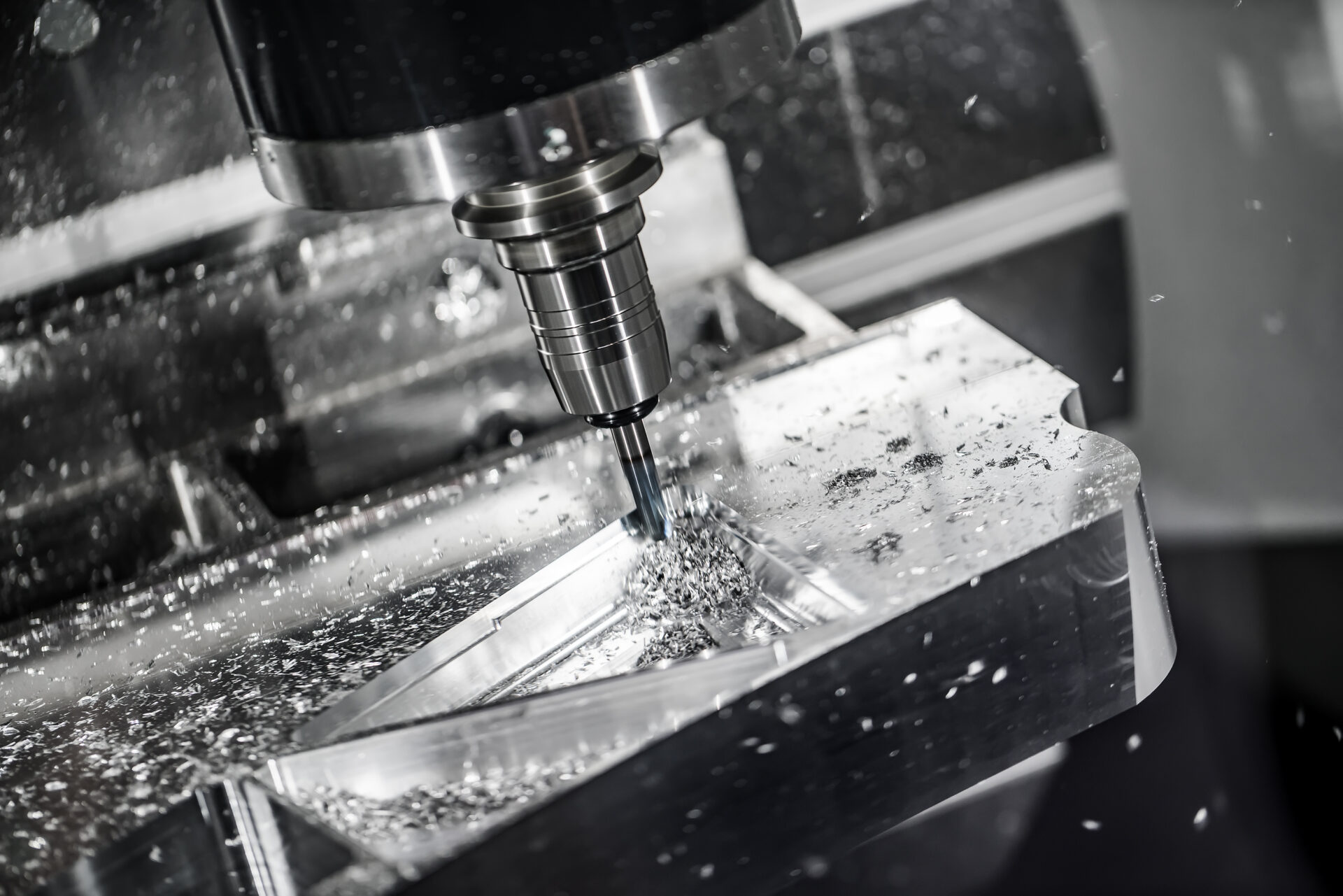
These errors can stem from tool deflection, thermal expansion during long cycles, improper fixturing, accumulation of geometric errors in the machine, or insufficient in-process inspection. Shops running modern 5-axis machining centers mitigate these risks through single-setup strategies. Every time a part is removed and re-fixtured, the datum reference is effectively recreated, opening the door to positional variation. Maintaining a single setup preserves datum relationships throughout the cut, which matters most for components with complex spatial requirements: optical mounts demanding angular accuracy under 0.01°, multi-axis bore alignments in medical housings, or intersecting internal channels in fluid manifolds.
Process capability is equally important. A tolerance callout of ±0.005 mm is meaningless if the process cannot consistently hold it. Suppliers tracking Cp and Cpk values give engineers confidence that tolerances are sustainable across production, not just achievable on a handful of sample parts. Reaching Cp ≥ 1.67 on demanding features requires thermal stability in the machining environment, tool wear monitoring, stable fixturing, predictable material behavior, and skilled CNC programming.
Metrology and Design for Manufacturability
Machining accuracy only counts when verified. CMM systems capable of sub-micron measurement form the backbone of dimensional validation, confirming datum structures, evaluating GD&T compliance, and generating First Article Inspection reports that prove manufacturing reproduces design intent. Keeping inspection capability in-house alongside production eliminates the ambiguity that arises when multiple vendors handle different stages of a project.
Collaborative Design for Manufacturability feedback further closes the gap between what an engineer specifies and what a shop can reliably produce. Adjusting tolerances to match true functional requirements, improving tool access with practical corner radii, and optimizing datum structures to align with machining setups, these refinements improve both manufacturability and long-term part reliability without sacrificing performance.
Building a Resilient Supply Chain
Supplier selection is a technical decision that directly affects dimensional performance, reliability, and product success. Nearshoring to Canada within the USMCA framework provides tariff stability, favorable currency dynamics, short logistics chains, and access to advanced machining and metrology infrastructure. Combined with rigorous process control and genuine engineering collaboration, that foundation supports the manufacturing continuity and precision work demands, allowing engineers to design with confidence that their specifications will be met consistently over time.