
Innovation How Precision Machining Enables Thermal Stability In Commercial Electronics
Modern commercial electronics must manage heat efficiently to maintain stable performance and reliability, as integrated circuits generate heat continuously during operation. If that heat is not removed effectively, devices can experience performance throttling, component degradation, or even premature failure.
While cooling technologies such as heat sinks, thermal interface materials, and airflow design often receive the most attention, one enabling factor is frequently overlooked: precision machining. The ability to manufacture components with extremely tight tolerances and controlled surface finishes is key to efficient heat transfer and long-term reliability in electronic systems.
Surface Quality and Thermal Contact
The relationship between precision machining and thermal stability begins with surface quality. When processors, power regulators, or graphics chips generate heat, that thermal energy must be quickly transferred to a heat sink or the device’s structural chassis. Efficient transfer requires extremely flat and dimensionally accurate contact surfaces.
Microscopic irregularities or dimensional deviations create tiny air gaps between surfaces. Because air is a poor thermal conductor, these gaps introduce thermal resistance, which reduces the efficiency of heat transfer.
High-accuracy CNC machining enables the production of metal surfaces with tightly controlled flatness and surface roughness. By maximizing the real contact area between components, precision machining enables more efficient heat transfer from the chip to the cooling structure.
Optimizing Thermal Interface Materials
Most electronic devices rely on thermal interface materials (TIMs) to improve heat conduction between chips and heat sinks. These materials are designed to fill microscopic surface imperfections that would otherwise trap air.
Precision machining allows heat sink bases and cooling plates to be manufactured with very tight dimensional tolerances to minimize the gap between contact surfaces. As a result, the TIM layer can be thinner and more uniform, which significantly reduces thermal resistance and improves overall heat transfer efficiency from the semiconductor package to the heat-dissipation system.
In high-performance electronics, even small reductions in thermal resistance can translate into meaningful improvements in performance and reliability.
Precision-Machined Heat Sink Geometry
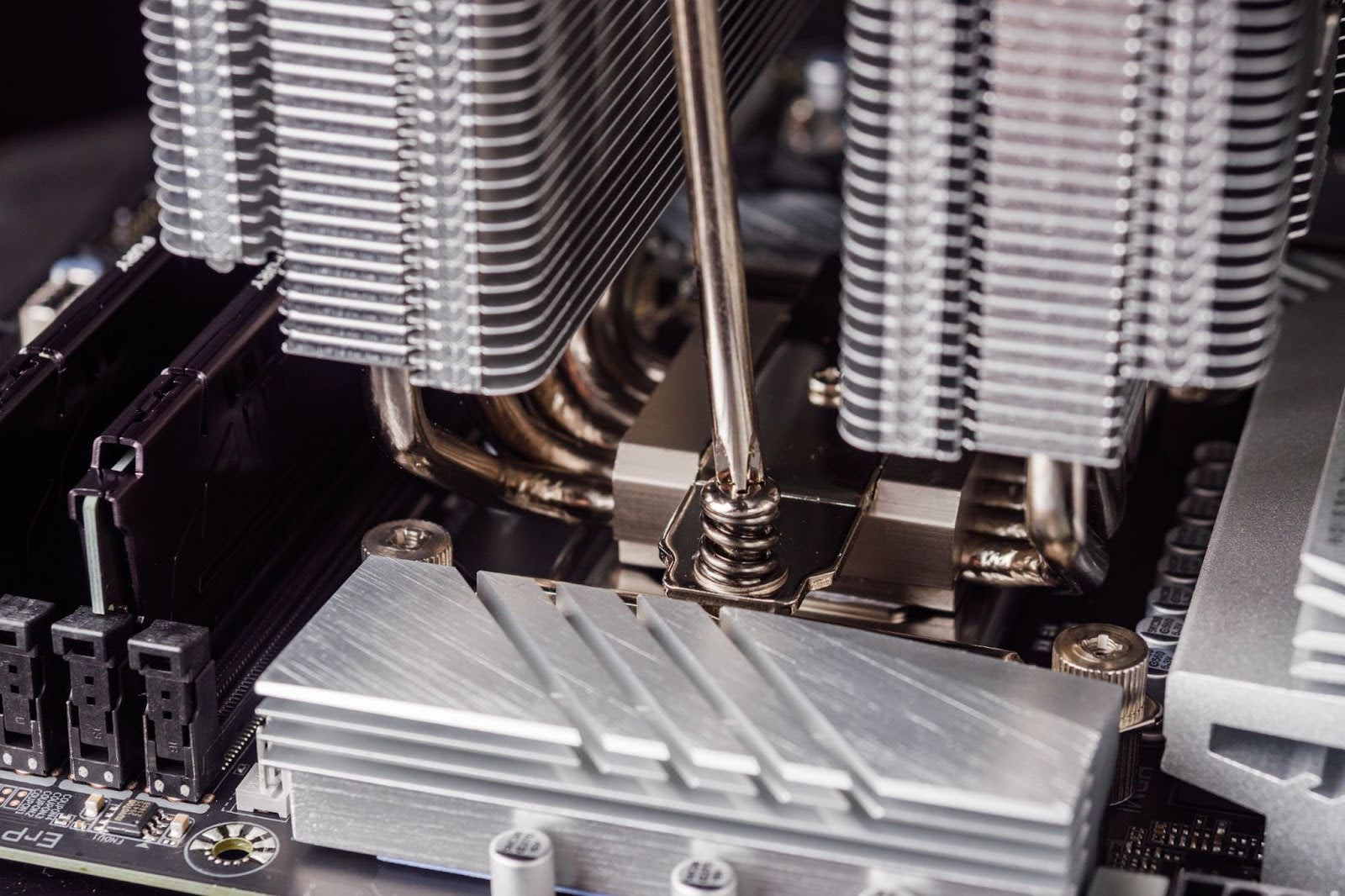
Heat sink performance depends not only on material properties, typically aluminum or copper, but also on geometric design. Commercial electronic devices often use heat sinks with complex structures, such as thin fins and microchannels, to increase surface area and improve airflow.
A larger exposed surface allows more heat to be transferred to the surrounding air by convection. Precision machining technologies make it possible to manufacture these intricate geometries while maintaining consistent fin thickness, spacing, and structural integrity. This level of accuracy ensures that airflow behaves as intended and that the heat sink performs at its designed efficiency.
Enabling Stable Thermal Performance
Precision machining is a key enabler of thermal performance in electronic systems. By delivering highly accurate geometries and surface finishes, it improves heat transfer between components, reduces thermal resistance at critical interfaces, and enables efficient heat-sink designs.
Achieving this level of thermal performance requires advanced machining capabilities, including high-precision CNC milling, multi-axis machining, and rigorous dimensional inspection throughout the manufacturing process.
As electronic devices continue to shrink and become more powerful, maintaining stable operating temperatures becomes increasingly challenging. Precision machining helps create the physical conditions that allow heat to move, spread, and dissipate efficiently, which supports reliable performance in modern electronic components used across industries such as telecommunications, computing, and industrial electronics.